Saturday, June 18, 2011

4. And Another Thing...

By: Eion Colfer

I'm not sure whether to blame short term memory or willful delusion to explain why I'd go and read yet another Douglas Adams style book by someone other than Douglas Adams. However, seeing as this is the 'official' sixth book in the even more now inappropriately named Hitchhiker trilogy, and seeing as the last book, Mostly Harmless ends on a bit of a downer, I felt the need to plow on, even if the franchise was handed over to new management.

Admittedly, the first chapter or so fooled me- it does start off quite good. Even the title is clever- like all the other books (since the first) the title is a reference to one of the books that it followed. In this case the title comes from the line in So Long and Thanks for All the Fish:
The storm had now definitely abated, and what thunder there was now grumbled over more distant hills, like a man saying "And another thing…" twenty minutes after admitting he's lost the argument.
The suggestion being that this book, in itself, is an unneeded post-script that will add nothing to the existing canon. You have to appreciate that kind of self-depricating irony. The first chapter finds the main characters living lives of luxury before they are whisked back to their current reality- where we left off in Mostly Harmless (roll over for spoilers) in the midst of earth's second destruction. At first, Colfer does a pretty amazing job at recreating the feel of a true Adams novel; he captures the Arthur Dent that is somehow both constantly miserable and likable at the same time. He nails the Ford Prefect who is seems so genuinely deep because of his ridiculous shallowness. He gets the comic relief of Zaphod pretty quickly with a neat turn of events for that character. Trillian is probably the least well fleshed out in the new book, but to be fair, she's not all that well fleshed out in the original series either (I'd like to cite as evidence for this how radically different she's portrayed in the film and BBC versions of the original book- much more so than any of the other characters).

Unfortunately, after that things start to fall apart. Perhaps part of this came from Colfer's attempt to salvage some of the ideas in Salmon of a Doubt into a workable new book. Prehaps it stems from what feels like a need to fill the book with clever in-jokes and references to minor characters and events from the previous novels. More likely it comes from the return of small characters that were originally only intended as funny asides, not to be brought back as major players. Certainly it comes from a weak plot which reads more like a post-script (and another thing...) to the original story, rather than the big finale that Adams never had the chance to pen himself. I can't pinpoint exactly what the problem is, but I can pinpoint exactly where it started to fall apart for me- where the title is funny and ironically meta- he riffs on improbability in another way that might have also been self-depricating, but comes across as a treatise on the banality of Adams' humor. In a guide entry, he writes that just about any two words selected at random and put together will find tons of listings in the H2G2- and while this simple concept is at the heart of some of Adams' funny asides, its also to be found in the basic assumptions of Surrealism - that new ideas are generated when two unrelated ideas are juxtaposed. While the 'meta-ness' of the title is endearing to the point that you can actually allow someone else to pick up the story where Adams left off, this passage seemed poorly conceived and vaguely insulting to Adams' legacy. True, this juxtaposition of randomness is one thing that Adams does- but he does it so well. I don't doubt it was intended as an homage to his style, but unfortunately, it doesn't read that way.

Finally, while this book finds a happier ending then Mostly Harmless, it's not all that much happier, we don't learn anything new, but more importantly, nothing changes for the characters, and they don't learn anything new. I really wanted to like this book, but the best I can say for it is that it has some very funny bits strung together by a pretty weak plot, and that it is really much better than Starship Titanic.



Thursday, April 14, 2011

3. The Conversations

Walter Murch and the Art of Editing Film
By: Michael Ondaatje

The Conversations is simply a series of discussions about the film editing process between fiction/non fiction writer Michael Ondaatje and Film Editor/Director Walter Murch. The real genius of this discussion though, is the depth of Murch's thoughts on the whole filmmaking process. He discusses a range of fascinating ideas. For example, why we can psychologically understand a film that jumps in time and place when it is so different from our experience of real life. How editing transforms meaning and represents a final draft of a film, beyond the script, and beyond what is shot.

He talks extensively about the possibility of a film notation (like musical notation) although to me, editing is closer to painting than music. That's just to say that I wasn't entirely convinced by this idea, but I'll defer to him on any big questions of editing.

More than anything else, Murch presents a fascinating discussion of editing as a true art form, and I doubt it possible to read this book and see it as anything else.

Monday, January 03, 2011

1&2: Scott Pilgrim: Precious Little Life and Scott Pilgrim Vs. the world

By: Brian Lee O'Malley


Were back here at Print is Dead after taking a year (and a half) hiatus for a bunch of reasons, not the least being a new baby, but mostly reasons that add up to my not having read much at all in the last year. This is not entirely true- I did read a bunch of art education type books (and even reviewed one on my other blog, which if I'd thought about it could have had at least one entry here last year if I cross posted, oh well). On to business:

Reading these two books confirms my feeling that it is not necessary and perhaps even counter productive to "read the book first". I thoroughly enjoyed Edgar Wright's film adaption of the Scott Pilgrim series, and would count it within my top 10 films of 2010. Wright's brilliant style is evident, even when filtered through the lenses of the "Hollywood Mainstream Machine" and the "Comic Book Adaptation Paradox" (these are two 'lenses' that I just made up, the first needs no explanation, and the second one I don't have a good explanation of yet. It has something to do with the idea that you've basically already got a storyboard and know in advance what the film is going to look like, but on the other hand comics have adapted some 'cinematic' techniques in the way they tell their stories).

Where was I? Yes. The point was that had I read these books first, I might not have enjoyed the film as much as I did. Not so much that I would have gone in with raised expectations (although that is certainly part of it as well) but because there is really no way to portray these characters with any real fidelity to the comic. In Scott McCloud's Understanding Comics, he explains that the more simply that characters are drawn, the more we see of ourselves in them, and the more 'universal' they become (we all see a human face in a line and two dots if put in the right positions). Scott Pilgrim is simply drawn, and we identify with the characters not based on their complexity but on our ability to transfer ourselves into their lives. This doesn't mean that I don't think O'Malley has done a weak job at creating characters- quite the opposite- he's created characters which are both open to interpretation and specific and interesting (albeit mostly flat- at least, they are at this point in the story).

So the world of Scott Pilgrim is much richer in comic book form. Here there is time to get to know the characters a little better, and spend some time in the alternate-reality canada that Scott exists in. At the end of book 2, we're not even halfway through the scope of the film. This also represents one of my favorite sorts of fiction - it is magic realist (although a far cry from the original literary use of the term for the latin american work of Marquez and others) - but restrained. Most of the action takes place in a world similar to ours - a world in which we deal with the everyday mundanity of life by focusing on unimportant things like video games. However, every once in a while, we're removed from that world- in a way that is often much more subtle than how it is presented in the film. It would be nice if mainstream films could take their time to build a story like these comics do - and while they're at it, find this terrific balance of the familiar with the ridiculous.

Grades:
Scott Pilgrim's Precious Little Life: A-
Scott Pilgrim Vs. The World: A

Recommendation: Recommended for your next graphic novel reading endeavor.


Wednesday, March 18, 2009

5. Cauldron

By: Jack McDevitt

What will probably be the last of the Academy novels, Pricilla Hutchins finally confronts the mystery at the center of the universe that has been the source of the mysterious Omega clouds. With the invention of the Locarno Drive, the Academy is reborn form the ashes and the center of the universe is finally within reach. Unfortunately, Pricilla and the Academy have the bad luck of having their resurgence in an even numbered book, which means that the story is banal and little is advanced in the plot or character development. The final few pages are mildly interesting, although as many other reviewers note, McDevitt seems to have ripped off his series dramatic conclusion from a not-so-fantastic sci-fi film. Sort of a mediocre end to what was a mediocre series- more unfortunate because it all started out with one of my favorite sci fi books.

Its not just the hurried, weak, and familiar ending that ruins the book. Not much happens for the first half- its all about getting funding and support for the renewed space program. And another character, whose life was at stake for over 100 pages of Chindi, is killed off between books and mentioned only in passing. Amazing how if he's stuck on an alien spacecraft and running out of air, its drama- if its a slow death from cancer, its 2 sentences and forgotten.

Grade: C-
Recommendation: All in all, "The Engines of God" should be read alone, perhaps with "Chindi" as an interesting follow up for those who want to read something else in the series.

Sunday, March 08, 2009

4. Here We Remain

The Walking Dead
Vol. 9
Written by: Robert Kirkman
Illustrator: Charlie Adlard

The next chapter of the Walking Dead presents a bit of a lull in action from the last few chapters, which together built towards a brutal and long awaited climax. In the wake of the devastation of volume 8, Rick and what is left of his family and friends (being intentionally vague here so as not to ruin anything) look for a new safe haven.

This lull is necessary though, as the series marks the end of one massive story arc and begins another. The first 8 books describe in detail how people change and react to their horrific circumstances. By book 9, we know what the 'zombie apocalypse' has done to both the dead and the living. Now its finally time to turn back to the 'why' and 'how' - as in, how to get things back to normal. The potential solution comes as a bit of a deux-ex-machina, but in this case, it seems necessary to keep the series going, by at once continuing the themes from the last volumes, and starting new ones.

What is also pretty interesting in this 'long form' zombie narrative - is the long term effects of dealing with the horrific day-to-day exisitence of violence and survival. People adapt pretty quickly and often go off the deep end, but those who have been able to maintain their sanity begin to show cracks as well. Really a great psychological study in many ways.

Again, highly recommended, although this one was not as exciting as the last few, it whets the appetite for the next one.
Grade: A-

3. The White Mountains

The Tripods 1
By: John Christopher

After reading the good reviews of this on Olman's & Lantz's blogs, I had to pick it up when I found it here in Shanghai. They both did great reviews of it, so I'll keep mine short. Overall, it was a fun book and I'll pick up the next two when I find them. That being said, I had some mixed feelings about it, which boil down to the following:

I both like and dislike the unmentioned connection with War of the Worlds. Its pretty undeniable that this is written as an 'alternate reality' of the HG Wells version in which the Tripods win and then take over (albeit later in human history). Its almost like a remix or a mash-up - or a sequel to a book that wasn't quite written. However, it seems that there is something also odd about not acknowledging the original in some way.

Likewise I have mixed feelings about the writing style. Its not flowery or clever, its just there. Something happens, the characters react to it, and something else happens. The writing advances the plot and that's basically it. I can appreciate the clean and straightforwardness of that, but at the same time, I also wish it was a little meatier.

Grade: A- / C+ - it somehow manages to be both at once.
Recommendation: Its a fast read and you'll enjoy it if you're a sci fi geek.

Sunday, February 01, 2009

2. The Arrival

By: Shaun Tan

This is a fully remarkable book that conveys a complex story of isolation that can only be experienced as a stranger in a strange land.  The illustrations create a thoroughly rich and unique set of new worlds- each which operate under different rules. 

As an 'expat', I find myself moved by the inner struggle of the character as he balances the excitement of seeing new spaces with the tragedy of being separated from his loved ones.  

Or maybe I'm just reading into it.

Does this count towards fifty even if the only words are in the title? In any event, it makes an amazing case for visual literacy.  This would be an excellent book for any class that deals with storytelling. 

That, and this book proves once and for all, that print really is dead.

Grade: A+
Recommendation: Get it. Now. You'll thank me.  

Wednesday, January 28, 2009

1. Zot!

By: Scott McCloud

The first half of the book about a superhero from another world isn't anything groundbreaking.  The second half of the book, where said superhero becomes a background character in the lives of some ordinary teens going through ordinary teen problems is surprisingly extraordinary.  

McCloud's rich understanding of the comics conventions as detailed in his brilliant non-fiction comics books (Understanding Comics, Reinventing Comics, and Making Comics) are evident throughout.   For that reason alone, its a fascinating read.  

Recommendation: The second half should be required reading for comics aficionados. 


Sunday, December 21, 2008

Quick Reviews For a Neglected Blog

Graphic Novels:

24. Hellboy 1: Seed of Destruction
25. Hellboy 2: Wake the Devil
By: Mike Mignola

Hellboy in comic form is surprisingly different from the Hellboy movies. Ironically, the movies add more of a 'comics' feel to the original stories, which have a more serious tone and rely much more on a retelling of history through a "Lovecraftian" lens.

26. Y - The Last Man 1: Unmanned
27. Y - The Last Man 2: Cycles
28. Y - The Last Man 3: One Small Step
By Brian K. Vaughan and Pia Guerra

Y The Last Man is an interesting series about Yorik, the lone male survivor of a strange virus that suddenly wipes out the entire population of men on the planet. Why and how he survives in a world of women is the subject of this politically charged series. It doesn't quite have the compelling narrative of The Walking Dead, or the depth of Hellboy (looking at the other comics series I've been reading this year) but its enjoyably humorous, often poignant, and it uses the continuing narrative form of the monthly comic to tell a more complex story than could be told in a single book or film (and as television hasn't really caught on to the idea of telling extended narratives in 60 years its not even worth a comparison).

Professional Development:

29. Understanding by Design
By: Jay McTeigh and Grant Wiggins

A good book for setting up a framework for curriculum design. For me, it had a really interesting chapter on assessment strategies in which emphasis is placed on the student's own progress rather than his/her achievement as measured against the rest of the class.

For School:

30. Looking at Movies: An Introduction to Film
By: Richard M. Barsam

This is the textbook I'm using with my IB class this year. I was originally going to go with David Bordwell and Kristen Thompson's Film Art, which I used in college, but this book seemed more engaging. It also explains things a little bit better. Could have gone either way, both great books.

31. Film Art
By: David Bordwell and Kristen Thompson
Re-read the updated version. Still a good book, and will use parts of it in my class.

32. Film: A Critical Introduction:
By: Maria T. Pramaggiore
Not as good as Bordwell or Barsam's books, but it has a great section on film analysis.

33. Film History
By: David Bordwell
Pretty much an exhaustive history of film. To be fair, I skipped a few chapters as its not all relevant to the class I'm teaching. Interesting stuff though.

34. Cinematic Storytelling: The 100 Most Powerful Film Conventions
by Jennifer Van Sijll

Not really a 'sit down and read' book, but I'll take it. Each page explains a different film convention. Useful for my class.

35. Digital Photography for Dummies
by Julie Adair King and Serge Timacheff

Wasn't very helpful, no jokes please.

Non-Fiction

36. Stumbling on Happiness
By: Daniel Gilbert

Gilbert gives an excellent explanation as to why many people prevent themselves from being happy, and does it with an excellent sense of humor. Didn't really expect to like this book very much, but its really worth reading, especially when you're not feeling particularly happy.

37. The Power of Myth (reread)
By: Joseph Campbell

Re-read this for an article I'm writing about an art lesson I'm working on. Certainly on my top ten of all time.

Fiction:

38. The Eye of the World (partially read)
By: Robert Jordan

I know this is supposed to be the best fantasy since LOTR, but I've been struggling to get through this book for almost 8 months. I read a little and put it down every so often.

Tuesday, October 07, 2008

23. High Noon

20 Global Problems
20 Years to Solve Them

By: J.F. Rischard

Rischard makes a compelling case for 20 problems- political, environmental, and educational that require drastic attention in order to avoid massive global catastrophe.   For a few of these, he suggests even 20 years might be too late.

The key to this book is that he actually suggests some plausible solutions-  the core of which is the creation of "Global Issues Networks" to use the internet to coordinate various groups around the world who are already working on these issues.

The book is a tiny bit dry, although very readable, and very important.

Recommendation:  If you haven't read this yet, why do you hate teh earth so much?
Grade: A-

Sunday, October 05, 2008

22. Dreams From My Father

By: Barack Obama

Man, wouldn't it be awesome to have a president who is insightful, reflective, and intelligent - yeah, that's pretty much what I was thinking while reading this book. The book is a very personal reflection on growing up with mixed messages and ideas about race, culture, and identity- how the absence of his father left a big hole in his life and how he tried to fill it.

Recommendation: An important book to understanding the history and character of the 44th president. Will be considered a 'must read' for history students someday. Or maybe just history students studying the Obama administration.
Grade: A

Friday, October 03, 2008

21: Blue Pills

A Positive Love Story
By: Frederik Peeters

Touching true story about a guy who falls in love with an HIV+ woman, and their trials and tribulations in navigating the relationship and her young son who is also HIV+. Didn't like Peeters' drawing style though. Its hard to consolidate in my mind a narrative about an attractive woman who is drawn in blotchy thick ink lines. If I ever teach that class in Autobiographical Graphic Novels, this would be an important one to include. Otherwise....

Recommendation: Meh
Grade: B-

20: Johnny Bunko

The Last Career Guide You'll Ever Need
By: Daniel Pink.

Bunko is right.  The second part of the title is not.  Read it because I loved A Whole New Mind and wanted to see what else Pink had to say.  
Apparently, not much.   

Recommendation: Take a guess.
Grade: F

Friday, September 19, 2008

19. The Hollow Hills


By: Mary Stewart

Mostly Merlin just wanders around and prepares for book three. Sort of like the hobbits in Lord of the Rings.

Grade: B
Recommendation: Slog on through to the sequel.

Tuesday, September 16, 2008

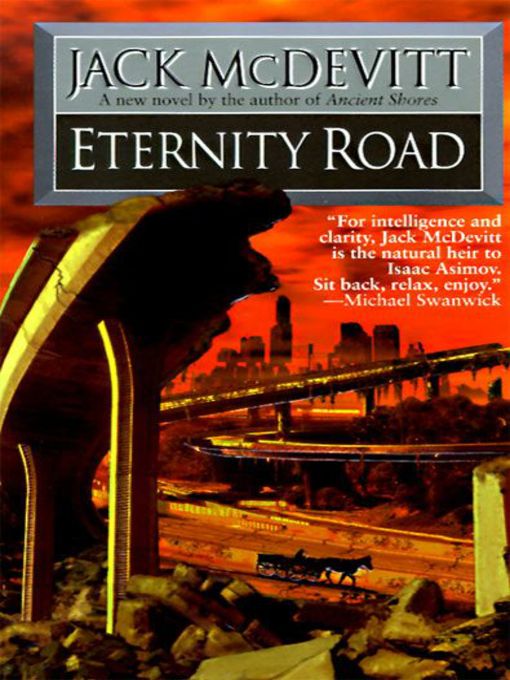
18. Eternity Road

by: Jack McDevitt

I have a huge backlog of stuff I read over the summer. So reviews for the time being are going to be short and sweet- otherwise i'll go on neglecting this blog.

The "roadmakers" were a prehistoric civilization that left massive cities and roads behind, but no evidence of how their incredible technology worked, or where they went. When one of their books shows up unexpectedly - Mark Twain's "Connecticut Yankee", an expedition to find their lost library - hopefully with answers about the lost civilization is launched.

The book doesn't try to hide the mystery of who the roadmakers were- McDevitt tells an engaging tale as always, but the book feels like it could have been more 'epic' if it wasn't confined to a single character's POV and limited timeline. I'm a big fan of his work, but it can be hit and miss- this one is the first that is neither 'hit' nor 'miss', just ok.

Grade: B
Recommendation: Engines of God is a must read. This one can be somewhere further down your McDevitt collection.

Monday, September 15, 2008

17. League of Extraordinary Gentlemen: The Black Dossier

By: Alan Moore and Kevin O'Neill

What will most likely be the final installment of the League of Extraordinary Gentlemen series unfortunately misses the epic grandeur of the previous two editions by more than, well, I would have expected from Moore. This sad tome, "The Black Dossier" would more appropriately have been titled "A Short History of Nearly Everything That I'd Like to explore in Further Detail In This Series If I was Actually Serious About Doing It, But I'm Not So I'll Just Tell You What I Would Have Done and Take a Few of Your Hard Earned Dollars For My Troubles". At least, it would have been a more honest title. The writing in this book is so uncharacteristically sloppy, so uncharacteristically disjointed, and often so nonsensical that only the slightest appreciation for Moore's ingenuity and quirky style keeps the pages turning.

Grade: D-
Recommendation: Read the first two graphic novels if you haven't yet. Its better to pretend that this one doesn't exist.

Friday, July 18, 2008

15 & 16. Buffy: Season 8

Part II:
No Future for You

Part III:
Wolves at the Gate

By Joss Whedon

As stated in the review down the page, Part I reintroduces us to the "Buffyverse", picking up where the television series left off.  For the purposes of not spoiling the end of the series, I'll continue to be vague, but suffice to say, Buffy's team has expanded now well beyond the "Scooby Gang" as her friends in the series were known.  

Interestingly, the "boss" villain, who is usually introduced on the early side in the series doesn't make his appearance until Part II of "season 8", and even then we don't know much about him- the mysterious figure called "Twilight" who has yet another apocalyptic plan.   

In order to keep these villains interesting (because they all have apocalyptic plans), Twilight is unique because rather than fight his own battles, he manipulates the various players as chess pieces - pitting slayer against demon, slayer against witch, slayer against slayer, slayer against US Army.  

The beautiful thing about these books is that they manage to capture not just the clever dialog that is so key to the show, but also the comedy, the tragedy, the awkward pauses, the teen abuse of language, and the complicated relationships of the various characters... and what makes it even more amazing is that long after the actors and actresses have abandoned their roles, their characters are still growing and changing.  Moreover, characters who have never appeared "in real life" on the television show are handled with equal depth and complexity.  

My only (minor) criticism is that it still feels a little "cameo happy", but for the most part, it works. 

Recommendation: Its the best thing next to the TV show, and it only gets better. 
Grade: A

7-14: The Walking Dead

7. Days Gone By
8. Miles Behind Us
9. Safety Behind Bars
10. The Heart's Desire
11. The Best Defense
12. The Sorrowful Life
13. The Calm Before
14. Made to Suffer

Written by: Robert Kirkland
Illustrated by: Tony Moore

Ah, I have wanted to read this series for a long time, but 8 graphic novels is a big investment.  So nice to have found them on Bit Torrent.  
The story opens with protagonist, police officer Rick Grimes, taking a nearly fatal bullet which lands him in a coma in the hospital.  Lucky for him, because he sleeps through the onset of  the zombie apocalypse.  Unfortunately, when he awakens, he is alone, his family is gone, and no one is explaining the dead-ish folks who are trying to eat him.

The Walking Dead more or less follows the Romero formula for Zombies: They're dumb, slow, and relentless.  Despite owing this massive debt to its predecessors, in a lot of ways, WD is one of the most successful Zombie stories of all - as it has run for now four years, it has had the opportunity to develop a sense of not just what its like to be faced with the end of the world- but how it must be endured day after day, month after month, and year after year.

...and in this way, WD pulls no punches.   It works exceptionally well as a horror story- no one is safe, and Throughout its run, characters who you grow to know and love will often succumb to the undead horror.  Its a tough world.  

It draws on some of the best elements of the Zombie movies that have inspired it- its crisp black and white is no doubt influenced by the original Night of the Living Dead, the issues of how communities of humans devolve owes a debt to 28 Days Later and the sometimes ridiculous gore tips a hat to the 80s zombie flicks that had to top each other for most grotesque killings.  

However, the sheer scope of this story is what separates The Walking Dead from any other zombie story.  The 48 chapters (so far) allow characters to develop in response and reaction to their world.  The mild mannered and fair Rick must become a fearless -and ruthless leader.  The god fearing farmer must accept a life of violence.  Those who need to cling to their pre-apocalypse self concept are often the most rudely awakened. 

Recommendation: For anyone who is a zombie (or horror) aficionado - this is a unmissable classic. A+

Tuesday, April 29, 2008

6. Nightwatch

By: Sergei Lukyanenko

Here's one of those odd instances where the movie actually does live up to the book- and the reason that this works is because the movie tells its own story, and doesn't try to recreate the scope of the novel. I don't know if I'd consider that a 'successful adaptation' or not, since the success lies in its non-adaptiveness. Anyway, there is too much that happens in the book to be translated into the movie, and because the book is episodic, it would not make for a good 'epic' the way the film does.

In modern Moscow, the Nightwatch polices the forces of the dark - vampires, dark magicians, werewolves. However, the Daywatch polices the forces of light- the good magicians and shape shifters. The two forces that vie for the fate of man rely on a mutual treaty, without which they would be pitched in a bloody battle that would wipe out the human race, and neither side would be able to 'turn' them. The result is a world in which 'good' and 'evil' do exist, but in compromised form. The result is the grey area of modern life.

Recommendation: Watch the movie, if you like it, go deeper into the story by reading the book.

Tuesday, April 22, 2008

5. Buffy: Season 8

Part I
By: Joss Wheedon

Buffy was one of those rare shows that managed to to break through the boxy little genres of television to create something that was totally new. It featured a rich universe of believable three dimensional characters with well written dialog whose 'real life' problems fit in perfectly with the fantasy setting. By the end of season seven, these characters had changed and grown to the point that taking them further would have been nearly impossible without creating a massive shark jumping. Wheedon's characters had fought their own demons (pun intended) and saved the world (one last time), and he ends on a note that would have unequivocally changed the direction and content of the show in a way that would have distanced it too much from where it began. The show had run its course and ended when it needed to.

Continuing Buffy's story in comic book form however, was the perfect way to see what happens in the next chapter of the lives of Buffy n' pals. The show is left with an appropriate conclusion, and the comic investigates all of the interesting suggestions of 'what happens next' that the show leaves open.

Its hard to talk too much about even the premise of the comic without giving away the events of the season finale, so I won't comment too much on plot. Suffice to say, there are more demons to be fought, and there's a great 'war on terror' allegory plot that builds in the first part of "Season 8". Wheedon's topical humor is still present - so is his witty writing, and the characters come through in comic form as they would on the show. However, you see the characters continue to grow as well. Xander is older and more together (although still a bit awkward in his geekiness), Buffy has come to terms with her past and has brightened back up, but she's still not the happy-go-lucky kid that was found at the beginning of the series. There are a few surprise faces from the TV series that show up in the dramatic conclusions of chapters, but that plot device doesn't seem to ring as startling without the tense music and commercial break.

Overall, Season 8 gets off to a great start and expands the story line in a way that probably wouldn't have worked on TV, but works quite well in comic form.

Recommendation: Get on your Netflix queue and fill it with Buffy seasons 1-7. Once you're thoroughly wrapped up in the slayer life, read the comic.